
How to Choose a Tile Display Rack Supplier in 2026

Choosing a Tile Display Rack Supplier in 2026 is a practical decision with visible consequences. A chipped sample, a wobbly shelf, or a rack that blocks the tile’s finish can undermine a showroom display. Buyers need more than a low unit price. They need consistent fabrication, clear loading specifications, dependable packaging, and samples that arrive ready to install.

The wider tile market gives this decision context, but not a shortcut. Grand View Research estimated the global ceramic tiles market at USD 207.7 billion in 2023 and forecast a 6.9% compound annual growth rate from 2024 to 2030. That report measures tile demand, not display-rack suppliers. Still, it points to a large market where retailers and manufacturers compete for attention. The rack is part of that encounter. A useful supplier should explain steel thickness, finish options, sample capacity, lead times, and how the unit performs when customers handle heavy boards. Ask for drawings. Check the welds. Request a production sample.

Details matter. Small things do.

Supplier claims also deserve scrutiny. Compare written specifications with the delivered rack, and ask how defects or transit damage are handled. No source material here verifies a named Tile Display Rack Supplier expert’s published quotation, so attributing one would risk misleading readers. This guide instead focuses on checkable evidence: product samples, factory capability, communication, and documented quality controls. Some criteria may need adjustment for your showroom. That is worth admitting early.
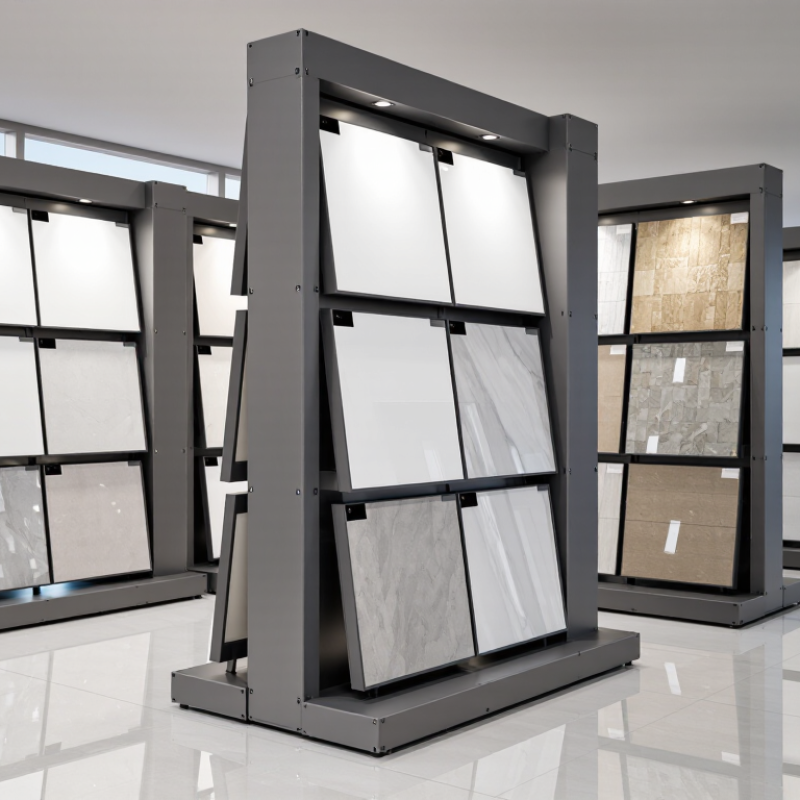
How to Choose a Tile Display Rack Supplier in 2026

Map Tile Samples by ANSI A137.1 Size, Thickness, and Finish Classes

A tile rack should help buyers compare samples without guessing. Group ceramic tiles by nominal size, then label actual dimensions and caliber when the supplier provides them. ANSI A137.1 offers a useful reference for ceramic tile terminology and requirements, but the display label should match the product’s current technical sheet. A 12-by-24-inch sample can look uniform on a rack while small dimensional differences affect layout planning.

Keep thickness visible as a separate measurement, not an assumed size category. State the measurement in millimeters or inches, and use the same unit throughout the display. For finishes, sort samples into clear descriptions such as matte, polished, glazed, or textured. These are practical display groupings, not a substitute for the manufacturer’s specification. Add a small, tactile sample where possible. A glossy surface can look calm under showroom lights and feel quite different in hand.

Rack labels need to stay readable from standing height. Include the tile type, nominal size, measured thickness, finish, and a reference to the relevant technical sheet. We have seen tidy displays hide useful details; neat rows are not enough. Check that samples can be removed without scraping neighboring edges, and update labels when product data changes. A little inconsistency in finish wording can still confuse a buyer, so review the categories with the people who handle samples every day.

Calculate Shelf Loads from Sample Mass and SKU Count Before Comparing Quotes

Before requesting quotes for a tile display rack, calculate the sample load for each shelf. Weigh a typical tile, then multiply its mass by the number of samples displayed. For example, eight samples at 3.2 kilograms each create a 25.6-kilogram load. Include sample boards, trays, and other items resting on the shelf. Small details matter. A heavy corner sample can shift the load unevenly.

List the planned SKU count per shelf, not just the total number of products. Then estimate each shelf’s load and the rack’s combined load. My first estimate is rarely perfect; tile thickness and backing materials can vary between samples. Weigh a few representative pieces, including the heaviest, and note how they will sit. That is not enough. Ask suppliers to confirm the rated capacity for the actual shelf width, supports, and configuration you intend to order.

When comparing quotes, give every supplier the same SKU layout and sample weights. Request written shelf-load limits, along with any conditions affecting those limits. A rack rated for a certain load may require evenly distributed samples or specific support spacing. Check whether the quoted design matches your display plan, rather than comparing price alone. If a supplier cannot explain its load rating, request clarification before approving the specification.

Calculate Tile Sample Loads Before Comparing Rack Quotes

Estimated total sample mass by SKU count, assuming two samples per SKU and an average mass of 2.5 kg per sample.

How to use this estimate: Total sample mass = SKU count × samples per SKU × average sample mass. These illustrative values equal 5 kg per SKU. Weigh your actual samples and confirm how the load is distributed across shelves before requesting quotes; total rack capacity and individual shelf capacity are different requirements.

Test Rack Safety Against EN 16121:2023 and EN 16122:2012

When choosing a tile display rack supplier in 2026, ask for test evidence against EN 16121:2023 and EN 16122:2012. EN 16121 sets safety and performance requirements for non-domestic storage furniture; EN 16122 provides test methods for strength, durability, and stability. These standards do not create one universal safe load for every rack. Ask which use category and configuration the test covers, then compare that evidence with your tile sizes and shelf layout. Small details matter.

Request the full test report, not just a pass statement. Check that it identifies the rack model, tested load, shelf spacing, anchoring conditions, and any limits on use. A useful assessment should consider loaded shelves, uneven loading, repeated handling, and stability on the floor surface where the rack will stand. The European Commission’s Safety Gate 2023 annual report recorded 3,412 alerts across product categories; these were not tile-rack-specific, but they underline the value of documented product checks. Ask the supplier how production units are checked against the tested sample. A report can be sound, yet a changed bracket or thinner panel may alter performance. That deserves a second look.

Verify Quality Controls Through ISO 9001:2015 Certification and Audit Records

When evaluating a tile display rack supplier in 2026, treat ISO 9001:2015 as evidence of a managed quality system—not a product guarantee. The ISO Survey of Management System Standard Certifications, 2022 edition, recorded 1,265,216 ISO 9001 certificates across 189 countries and economies. That scale shows broad adoption, but certification alone says little about a supplier’s control of your rack dimensions, welds, coatings, or rated loads.

Request a current certificate and check its scope, expiry date, and issuing certification body. Then ask to review recent audit records, corrective-action reports, and inspection logs. Useful records show how the factory handles defects, not just how it passes an audit. Look for checks on incoming steel, weld consistency, coating thickness, and load-test results. ISO 9001:2015 requires organizations to monitor processes and address nonconformities, but the paperwork should connect to actual production batches.

Make the review specific. Compare an audit record with a finished rack: measure a shelf, inspect a weld, and check coating around drilled holes. Ask what changed after the last documented defect. A polished certificate is easy to show. Clear answers and traceable records are more telling. Audits can miss problems, and I would not treat one clean report as proof of consistent performance.

How to Choose a Tile Display Rack Supplier in 2026 - Verify Quality Controls Through ISO 9001:2015 Certification and Audit Records
Review Area Evidence to Request What to Verify Relevant ISO 9001:2015 Clause
Certification validity and scope A current ISO 9001:2015 certificate, including the certified legal entity, site or sites, scope, certificate number, issue date, expiry date, and certification body. Check that the certificate is valid with the issuing certification body or an appropriate accreditation-directory search. Confirm that the listed scope and sites cover the operations making or controlling the racks. Certification alone does not establish that a particular product meets your specifications. Certification is issued by an external certification body; ISO 9001:2015 does not itself certify suppliers.
Order and design requirements Order review records, approved drawings, material and finish specifications, and revision history for a comparable rack. Confirm that dimensions, tile capacity, loading requirements, finishes, packaging, and other agreed requirements are documented and that current revisions are used in production. 8.2.3, Review of requirements for products and services; 7.5, Documented information
Supplier and material controls Approved-supplier evaluation records, purchase specifications, and incoming inspection or material acceptance records for relevant components. Check how externally provided materials and services are evaluated and controlled. For a rack, trace sample records for items such as steel sections, fasteners, coatings, or other specified materials to their acceptance criteria. 8.4, Control of externally provided processes, products and services
Production and process controls Work instructions, inspection checkpoints, equipment maintenance records, and production records from a recent comparable order. Look for controlled production steps and recorded checks for features relevant to the agreed design, such as dimensions, weld condition, surface finish, assembly, and fit. Verify that measuring equipment is suitable and, where required, calibrated or verified. 8.5.1, Control of production and service provision; 7.1.5, Monitoring and measuring resources
Inspection and product release Final inspection reports, acceptance records, and evidence identifying who authorized product release. Confirm that inspection results are compared with defined acceptance criteria and that release is traceable to the responsible person. Agree on any project-specific load or stability tests rather than assuming a test is covered by ISO certification. 8.6, Release of products and services
Nonconforming product control Redacted examples of nonconformance reports, disposition records, rework or reinspection records, and corrective-action follow-up. Check whether nonconforming items are identified and controlled to prevent unintended use or delivery, and whether corrective actions address causes when required. 8.7, Control of nonconforming outputs; 10.2, Nonconformity and corrective action
Internal audit records The audit programme and relevant internal-audit reports, findings, corrective actions, and closure evidence. Review records from the most recent completed audit cycle that relate to purchasing, production, inspection, and corrective action. Check whether findings have owners, due dates, and documented follow-up. ISO 9001 requires an audit programme but does not prescribe one universal audit frequency. 9.2, Internal audit
Management review and improvement Redacted management-review minutes or output records, including relevant quality trends and improvement actions. Look for evidence that the quality management system is reviewed and that actions are tracked. Useful topics include nonconformities, monitoring results, audit results, supplier performance, and improvement opportunities. 9.3, Management review; 10.3, Continual improvement
Records and traceability Sample production, inspection, and shipment records linked to a batch, order, or other defined identifier. Verify that records can connect the supplied rack to relevant specifications, inspection results, and release approval. Ask how long applicable records are retained and how access is controlled. 7.5, Documented information; 8.5.2, Identification and traceability
Buyer verification and follow-up Permission to review relevant redacted records, discuss findings with responsible personnel, and agree on actions for any identified gaps. Use the same documented checklist for shortlisted suppliers. Treat missing, expired, or out-of-scope certification and unresolved quality findings as issues requiring clarification before approval. Set any review period or pass threshold as your own purchasing policy; these are not ISO-prescribed requirements. Buyer-defined supplier qualification and monitoring process
Interpretation note: ISO 9001:2015 assesses a quality management system, not the design, load capacity, safety, or overall quality of a specific tile display rack. Verify product-specific requirements, test evidence, and contractual acceptance criteria separately.

Compare 2026 Quotes by MOQ, Lead Time, Warranty, and GS1 GTIN Data

When comparing 2026 tile display rack quotes, look beyond the unit price. Ask suppliers to state the minimum order quantity (MOQ), including whether sample racks count. A 40-rack minimum may suit a large showroom but leave a smaller retailer storing unused stock. Check whether the quote includes edge guards, labels, assembly hardware, and delivery to your actual site. Small omissions add up.

Lead time needs dates, not optimism. Request separate estimates for drawing approval, production, packing, and transit. Ask how delays will be communicated. A rack with custom slots for 60-by-120-centimeter tiles may need different tooling from a standard panel. Get a written warranty covering frame joints, finish, and replacement parts. Clarify exclusions for labor and freight. Read the fine print.

Treat GS1 GTIN data as a specific deliverable. Confirm whether the supplier can print or export the GTINs you provide, and request a sample file before approving the order. Check that each identifier matches the correct sellable product or package, with consistent descriptions and dimensions. Compare quotes by data format, update process, and responsibility for correcting errors. A polished spreadsheet is not proof of accurate records; it still needs review.

^