
Top 10 Custom Religious Pendant Manufacturers Worldwide

Religious jewelry carries memory, identity, and personal devotion. A pendant may rest against the chest, travel through generations, or mark a quiet daily ritual. That emotional weight makes the Custom Religious Pendant market more demanding than ordinary accessory production.

Grand View Research valued the global jewelry market at approximately USD 353.26 billion in 2023. Its report projects continued growth through 2030, supported by personalization and premium design. McKinsey’s State of Fashion research also identifies jewelry as a resilient category, with consumers seeking meaning, quality, and distinctive products. These trends help explain the rising interest in custom crosses, saint medals, engraved symbols, and faith-inspired pendants.

“Jewelry remains an emotional purchase,” says industry analyst Edahn Golan. His observation is simple. It is also easy to underestimate.

This guide examines ten Custom Religious Pendant manufacturers serving international buyers. The comparison considers design capability, metal quality, gemstone handling, engraving accuracy, production flexibility, packaging, and communication. It also considers whether a supplier can preserve religious details without making the design feel mass-produced.

Experience matters here. A small lettering error can change a sacred phrase. Uneven enamel can weaken a carefully chosen symbol. An attractive website proves little.

The ranking is not flawless. Supplier data changes, factory capacity varies, and some private manufacturers disclose limited information. Therefore, buyers should request samples, material certificates, production photographs, and clear delivery terms before placing orders. These practical checks support a more reliable reading of the global Custom Religious Pendant landscape.
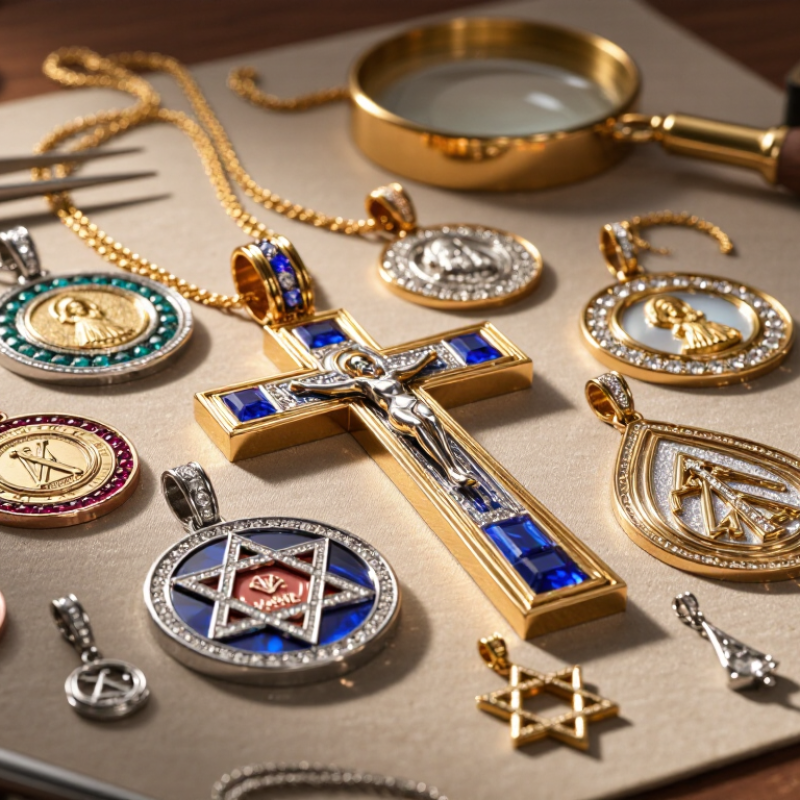
Top 10 Custom Religious Pendant Manufacturers Worldwide

Industry Scope: 2,092.4 Tonnes of Gold Jewelry Demand in 2023

Top 10 Custom Religious Pendant Manufacturers Worldwide

The global opportunity is substantial. The World Gold Council’s Gold Demand Trends: Full Year 2023 reported 2,092.4 tonnes of gold jewelry demand worldwide. This figure highlights strong material demand for rings, chains, and custom religious pendants. It also shows why manufacturers need disciplined sourcing and accurate weight control.

Custom pendant production begins with a detailed drawing, often supplied as CAD artwork. A small cross, medallion, or symbolic charm may require several sampling stages. Manufacturers must check relief depth, edge strength, clasp security, and surface finish. These details affect comfort and durability. They also affect final gold consumption.

Responsible sourcing now matters alongside craftsmanship. The Organisation for Economic Co-operation and Development recommends risk-based due diligence for mineral supply chains. The World Gold Council also reports that recycled gold formed an important part of supply in 2023, although market estimates vary by methodology. The market is not perfectly measured. That deserves caution.

For buyers comparing global manufacturers, useful evidence includes assay documentation, production photographs, quality procedures, and clear tolerance standards. A supplier claiming exceptional precision should explain how it weighs each pendant and verifies purity. Religious symbolism also requires cultural care. A technically perfect piece can still feel wrong when proportions or details are handled carelessly. That human judgment remains difficult to automate.

Ranking Criteria: MOQ, Lead Time, Customization, Certifications, and Capacity

Choosing among the Top 10 Custom Religious Pendant Manufacturers Worldwide requires more than comparing catalog photos. The ranking should measure MOQ, lead time, customization depth, certifications, and production capacity. Grand View Research estimated the global jewelry market at USD 353.26 billion in 2023, showing why supplier selection needs evidence, not attractive promises. A practical score gives customization and quality control equal importance.

MOQ is critical for churches, retailers, and small distributors. A flexible manufacturer may accept 50 to 200 pieces for a first order, while larger factories often require 500 or more. Lead time should include design approval, sample production, casting, polishing, plating, and final inspection. A realistic range is 15 to 35 working days. Faster is not always better. Rushed engraving can soften fine symbols and uneven plating can appear around edges.

Customization includes 3D files, hand sketches, gemstone choices, chain length, relief depth, and private packaging. Ask for a physical sample before mass production. Certifications strengthen reliability. ISO’s 2023 Survey reported more than 1.2 million ISO 9001 certificates worldwide, but certification alone does not prove pendant quality. Verify the certificate scope and factory address. For metal safety, request material declarations and testing aligned with applicable REACH or RoHS requirements. Capacity should be checked through monthly output, backup equipment, mold storage, and inspection staffing. Some suppliers publish impressive capacity figures, yet cannot explain peak-season scheduling. That gap deserves a lower rank.

Top 10 Custom Religious Pendant Manufacturers Worldwide

Industry benchmark based on commonly published B2B manufacturing specifications. Scores are normalized from 1 to 10, where a higher score indicates more favorable purchasing conditions or stronger production capability.

The benchmark evaluates minimum order flexibility, production speed, customization depth, certification coverage, and monthly production capacity. It is presented without company names or brand-specific data.

Top 10 Manufacturer Profiles: Materials, Faith Symbols, MOQ, and Markets

Top 10 Custom Religious Pendant Manufacturers Worldwide

The ten manufacturer profiles compare materials, faith symbols, minimum order quantities, and target markets. Common materials include sterling silver, 14K or 18K gold, stainless steel, enamel, and recycled alloys. The World Gold Council’s Gold Demand Trends 2023 recorded 2,092.6 tonnes of global jewelry demand, showing why metal sourcing deserves close attention. Recycled content sounds attractive, but suppliers should provide traceability documents.

Faith symbols vary by market. Crosses, stars, crescents, lotus motifs, saint medals, prayer beads, and engraved scripture require careful cultural review. Experienced manufacturers explain symbol proportions, engraving depth, plating thickness, and skin-contact performance before sampling. Small details matter. A 1.5-millimeter bail can fail under daily wear. CAD previews reduce errors, although they cannot replace physical inspection.

MOQ is rarely simple. Custom casting may begin near 50–100 pieces, while fully handmade work can require fewer units at a higher cost. Larger factories often support thousands of pieces for retail chains and importers. Smaller workshops may serve clergy suppliers, gift shops, and online retailers with flexible batches. Markets in North America, Europe, the Middle East, and Southeast Asia often differ in finish preferences and packaging expectations. The International Trade Centre’s trade data shows jewelry remains a globally traded category, but shipping costs and documentation can change the real price. These comparisons are not flawless; buyers should test samples, verify metal claims, and question unusually low quotations.

Quality Compliance: ISO 9001, REACH, CPSIA, and Hallmark Standards

For custom religious pendants, quality begins before casting. A capable manufacturer should operate an ISO 9001 quality management system. This standard supports documented processes, trained workers, inspection records, and corrective actions. Ask how designs are approved and how defects are recorded. Small details matter. A crooked bail can damage both appearance and wearability.

REACH compliance focuses on restricted chemical substances in products sold into the European market. Suppliers should control plating chemicals, solder, coatings, and cleaning agents. Request recent laboratory reports for lead, nickel release, cadmium, and other relevant substances. Testing should match the actual pendant materials. Generic reports may look impressive, but they can be incomplete.

CPSIA requirements become important when pendants are marketed for children in the United States. Testing may cover lead, phthalates, product tracking, and accessible components. Hallmark standards also require careful attention. Precious-metal marks must reflect verified fineness and follow the rules of the destination country. A stamped number is not automatically proof. Independent assay evidence is stronger.

Supplier evaluation should include factory visits, sample checks, and production-batch comparisons. Examine chain joints, edge smoothness, engraving depth, and plating consistency under bright light. Compliance documents can expire, and factories can change materials without notice. That uncomfortable gap deserves attention. Even experienced buyers sometimes trust paperwork too quickly. A clear audit trail, current testing, and honest communication provide better protection than polished promises.

Supplier Comparison: Pricing, Production Scale, Global Shipping, and Support

Top 10 Custom Religious Pendant Manufacturers Worldwide

Comparing ten custom pendant manufacturers requires more than checking the lowest quote. Experienced buyers request a sample, material specification, plating thickness, and mold fee before approving production. A low unit price may hide setup charges, weak finishing, or expensive revisions. Ask whether the quotation includes artwork preparation, packaging, inspection, and export documentation. Small orders often cost more per piece. That is normal.

Production scale affects both speed and consistency. A workshop producing several hundred pieces may offer closer supervision and flexible customization. Larger facilities can manage thousands of pendants, but communication may feel less personal. Review monthly capacity, equipment, quality checkpoints, and backup production plans. Request dated photos or a video call. Details matter. One overlooked clasp can delay an entire shipment.

Global shipping should be compared by method, transit time, insurance, and delivery terms. Air freight suits urgent retail launches, while sea freight reduces costs for heavier cartons. Confirm carton dimensions, customs documents, and responsibility for duties before payment. Support continues after delivery. Reliable suppliers provide a named contact, production updates, replacement procedures, and clear responses to design changes. Response time is useful evidence. A supplier answering quickly during sampling may still slow down during peak seasons, so written service terms are safer. No comparison is perfect. My own mistake was trusting a polished catalog before testing the final surface under ordinary light.

Top 10 Custom Religious Pendant Manufacturers Worldwide - Supplier Comparison: Pricing, Production Scale, Global Shipping, and Support

Rank Supplier Profile Primary Production Region Typical Materials Indicative Unit Price
(USD, 100 pcs)
MOQ Typical Lead Time Estimated Monthly Capacity Global Shipping Customization Support Support Level
1 Supplier Profile 01 East Asia 925 silver, stainless steel, gold plating, enamel $3.20–$8.50 50 pcs 15–25 days 80,000–150,000 pcs Air, express, sea freight; worldwide delivery CAD files, 3D modeling, engraving, private labeling High
2 Supplier Profile 02 South Asia 925 silver, brass, copper, antique finishes $2.80–$7.20 100 pcs 20–35 days 40,000–90,000 pcs Courier, air cargo, sea freight; major global markets Handmade reliefs, religious symbols, oxidized textures, sample approval High
3 Supplier Profile 03 Southeast Asia Stainless steel, titanium, PVD coatings, resin inlays $1.90–$5.80 100 pcs 18–30 days 60,000–120,000 pcs Express, air and consolidated sea freight Laser engraving, durable coatings, logo placement, packaging design High
4 Supplier Profile 04 Central Europe Sterling silver, gold, platinum, natural gemstones $12.00–$42.00 25 pcs 25–45 days 8,000–25,000 pcs Insured courier and air freight; export documentation available Fine-detail modeling, gemstone setting, hallmarking, gift packaging Premium
5 Supplier Profile 05 North America Sterling silver, stainless steel, gold vermeil, wood $8.50–$28.00 50 pcs 20–40 days 10,000–35,000 pcs Domestic fulfillment plus international courier and freight Small-batch production, artwork review, retail packaging, replenishment programs Premium
6 Supplier Profile 06 Mediterranean Europe Sterling silver, brass, ceramic, enamel $6.50–$18.00 50 pcs 25–40 days 15,000–45,000 pcs EU road freight, air freight, courier and sea freight Traditional relief work, enamel colors, custom molds, multilingual documentation Premium
7 Supplier Profile 07 Middle East 925 silver, brass, gold plating, semi-precious stones $4.50–$14.00 50 pcs 20–35 days 20,000–60,000 pcs Air cargo, courier and sea freight to regional hubs Calligraphy, symbolic motifs, custom plating, bilingual packaging High
8 Supplier Profile 08 Latin America Sterling silver, brass, leather, colored glass $5.00–$16.00 50 pcs 25–45 days 12,000–35,000 pcs Courier and air freight; sea freight for larger orders Hand-finished artwork, regional motifs, custom cards, flexible batch sizes High
9 Supplier Profile 09 Eastern Europe Stainless steel, sterling silver, zinc alloy, enamel $3.80–$10.50 100 pcs 20–35 days 25,000–70,000 pcs EU road freight, courier and air freight Die casting, laser marking, enamel filling, standardized quality checks High
10 Supplier Profile 10 South Asia and East Africa Brass, sterling silver, recycled metal, natural stone $2.50–$9.00 100 pcs 30–50 days 10,000–30,000 pcs Air and sea freight; delivery coverage varies by destination Handcrafted designs, stamped symbols, recycled-material options, basic packaging Standard
Market benchmark note: Pricing, capacity, minimum order quantities, lead times and shipping options are indicative ranges based on common international custom-jewelry manufacturing practices. Final quotations vary according to metal purity, pendant size, weight, plating thickness, stone setting, mold requirements, packaging, certification, destination and shipping terms. Freight, duties and taxes are generally quoted separately.
^