China has become a major manufacturing base for wall panels, offering PVC, SPC, aluminum composite, and fiber-cement solutions. The opportunity is substantial, but product quality varies sharply between factories. A polished sample does not prove long-term waterproof performance.
Grand View Research reports that the global wall panels market was valued at approximately USD 11.7 billion in 2023, with continued growth expected through 2030. Fortune Business Insights also estimates the global waterproofing systems market at about USD 11.9 billion in 2023. These figures suggest strong demand, yet they do not guarantee suitable products for bathrooms, kitchens, basements, or coastal buildings. Buyers must examine test reports, joint designs, surface wear, fire ratings, and installation instructions.
Joe Lstiburek, Ph.D., a respected building-science expert, has stated, “Water is a powerful solvent.” That simple warning explains why water proof wall panels need more than a water-resistant surface. Sealed edges, stable substrates, and correctly fitted trims matter just as much. In practice, I would request EN 13523, ASTM, or equivalent test evidence, depending on the project location. I would also inspect factory consistency, not only one attractive sample.
No panel is perfect.
Some suppliers may describe panels as fully waterproof without explaining seams or wall preparation. That is where careful comparison becomes necessary. This guide evaluates China-made options through material performance, independent testing, supplier transparency, installation reliability, and total project cost. The final choice should resist water, remain visually stable, and still perform after years of daily use.
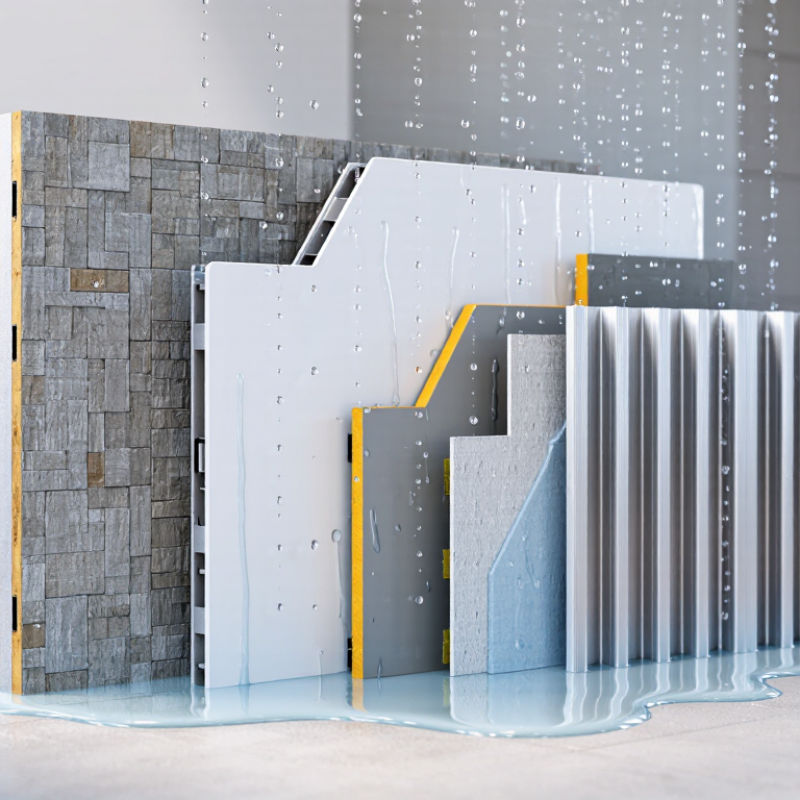
Waterproof wall panels are engineered boards with a low-absorption core and a sealed decorative surface. Common materials include PVC, WPC, SPC, aluminum composite, and fiber-cement. Unlike ordinary painted drywall, these panels resist liquid water at the face. Their real performance depends on the joints, corners, and penetrations.
The mechanism is straightforward. A dense surface blocks water entry, while tongue-and-groove edges or sealant reduce movement through seams. In a bathroom, installers should seal every corner, pipe opening, and panel connection. A small gap can defeat an expensive panel. That is the uncomfortable truth.
Grand View Research estimated the global wall panels market at about USD 16.3 billion in 2023, with continued growth expected through 2030. This demand reflects faster renovation and cleaner installation methods. However, market growth does not prove every product is reliable. Buyers should request water-absorption results, dimensional-stability data, fire-performance documentation, and independent test records. ASTM D570 can help assess plastic water absorption, while ASTM E84 is commonly used for surface-burning behavior. These tests measure different risks.
From practical installation experience, a rigid panel may look waterproof but still fail on an uneven wall. Chinese suppliers offer many surface finishes, thicknesses, and custom sizes, yet quality varies between production batches. Check sample edges, inspect the core, and test a sealed joint under repeated spray. Do not judge performance by appearance alone.
China manufactures several waterproof wall-panel types, each suited to different rooms and budgets. PVC panels are lightweight, affordable, and easy to clean. Their sealed surfaces work well in bathrooms, laundry rooms, and commercial wash areas. SPC panels add a rigid mineral core, improving impact resistance and dimensional stability. They usually imitate stone, wood, or concrete.
WPC panels combine wood fiber with polymer resin. They offer warmer textures, but prolonged standing water can still damage poorly sealed edges. Aluminum composite panels resist moisture and remain light, making them useful for kitchens and retail interiors. Compact laminate panels provide strong impact resistance and low water absorption. Large-format ceramic and porcelain panels offer excellent durability, although cutting and installation require experienced workers.
China also produces FRP panels for factories, hospitals, and utility spaces. They resist chemicals better than many decorative products. However, surface performance varies sharply between suppliers. I would not trust a glossy sample alone. Request water-absorption data, fire classification, formaldehyde testing, and edge-sealing details.
The National Bureau of Statistics reported China’s construction industry added value at about RMB 8.56 trillion in 2023. That scale supports a broad domestic supply chain, but quality remains uneven. The 2023 China Statistical Yearbook also recorded continuing growth in completed building areas, increasing demand for moisture-resistant interior materials. For specification work, compare test reports with actual installation conditions. A panel rated waterproof may still fail around joints, corners, and penetrations.
What Are the Best Waterproof Wall Panels from China?
Comparing Chinese waterproof wall panels requires more than checking the lowest quotation. Start with the panel structure, surface finish, and edge treatment. A dense core should feel firm, not hollow or unusually light. Inspect several samples under strong light. Uneven color, bubbling film, or rough cut edges may signal weak production control. Ask for material specifications, moisture-resistance data, and relevant fire-test reports from independent laboratories. Documents matter, but they should match the actual batch.
Cost comparison should include more than the factory price. Add packaging, inland transport, shipping, import duties, installation, and possible waste. A cheaper panel can become expensive after damaged corners or difficult cutting. Compare the same thickness, dimensions, surface texture, and accessory package. Request a sample installation before placing a large order. Watch how the joints close and whether the panels remain stable after repeated cleaning.
Do not trust impressive photos alone. Request recent production videos, batch records, and references from comparable projects. Check warranty terms carefully, especially exclusions for poor ventilation or incorrect installation. I would also test a spare sample with water, heat, and household cleaners. This is not a perfect laboratory method. Still, it can reveal swelling, color transfer, or weak bonding. One detail is easy to miss: panel quality may vary between batches, so written inspection criteria are essential.
Comparing common panel types by typical export cost and water absorption performance
The cost figures are indicative China export-price midpoints in USD per square meter, excluding freight and installation. Water absorption is a representative technical benchmark; lower values generally indicate stronger moisture resistance. Actual results vary according to thickness, core composition, surface treatment, testing standard, and supplier specifications.
What Are the Best Waterproof Wall Panels from China?
Reliable Chinese wall panel suppliers should provide certifications that match your project and destination market. ISO 9001 shows controlled quality procedures, but it does not prove waterproof performance. Ask for laboratory reports covering water absorption, dimensional stability, surface adhesion, and mold resistance. These reports should identify the exact panel model, thickness, test date, and testing method.
For European projects, request applicable CE documentation and a Declaration of Performance when required. For North American projects, look for test results based on relevant ASTM or comparable building standards. Fire reaction, smoke development, formaldehyde emissions, and VOC testing also deserve attention. An environmental certificate can support green building claims, but it should not replace technical evidence. Check whether an independent laboratory issued the report. Factory-only documents may be useful, yet they need closer verification. I have seen specifications change quietly after approval.
Tips: Compare certificates with the product sample. Confirm the supplier’s legal company name, factory address, certificate scope, and expiry date. Request batch traceability and a recent inspection report. Ask how failed tests are handled. A supplier that answers clearly is usually easier to manage. Still, confidence should come from documents and samples, not polished promises. Install a small test area before ordering large quantities. Watch the joints, corners, and sealant after repeated water exposure. Those details often reveal weaknesses that certificates cannot show.
| Evaluation Area | Recommended Requirement | Relevant Standard or Document | Evidence to Request from the Supplier | Why It Matters |
|---|---|---|---|---|
| Panel Material | Use a moisture-resistant core, such as PVC, aluminum composite, fiber-cement, cement-based, or another documented waterproof construction. | Product technical specification and bill of materials | Material composition, core density, coating type, adhesive compatibility, and product data sheet | Water resistance depends on the entire panel system, including the core, surface, edges, joints, and installation method. |
| Water Absorption | The supplier should provide a measured water-absorption result and explain the test method. Lower absorption is generally preferable for wet-area applications. | Applicable ISO, ASTM, EN, or Chinese GB/T test method stated on the report | Independent laboratory report showing specimen size, conditioning, immersion time, calculation method, and result | A generic “100% waterproof” claim is not sufficient without a defined test method and product-specific result. |
| Dimensional Stability | Confirm thickness, length, width, squareness, flatness, and moisture-related expansion or shrinkage limits. | Product-specific dimensional and thermal-moisture test standard | Quality-control specification and recent test report for the exact model and thickness | Stable dimensions help prevent open joints, buckling, and cracking after installation in humid environments. |
| Surface and Edge Protection | The decorative surface should resist moisture, staining, cleaning chemicals, and normal abrasion; exposed edges should be sealed where required. | Coating, abrasion, stain, chemical-resistance, and adhesion test methods applicable to the finish | Finish specification, cleaning instructions, coating adhesion result, and edge-sealing instructions | Many failures occur at cut edges, penetrations, fastener points, and unsealed panel joints rather than on the finished face. |
| Fire Performance | Select a fire classification suitable for the building type and local code; do not infer fire performance from waterproof performance. | EN 13501-1, ASTM E84, or the applicable national fire-test system | Fire-test report or classification report for the exact panel, thickness, coating, and installation configuration | A panel can be highly moisture-resistant but still have unsuitable flame-spread or smoke-performance characteristics. |
| Indoor Air Quality | For interior applications, verify formaldehyde and volatile organic compound emissions against the destination-market requirements. | Applicable EN, ISO, ASTM, or national indoor-air-emission method | Emissions test report, material safety data sheet, and adhesive or coating declaration | The panel, adhesive, coating, and backing system can all contribute to indoor emissions. |
| ISO 9001 Quality Management | Prefer a valid ISO 9001 certificate covering the manufacturing site and the relevant wall-panel production scope. | ISO 9001:2015 | Certificate number, certification body, scope, manufacturing address, issue date, expiry date, and verification link | It demonstrates a documented quality-management system, but it does not by itself prove that a specific panel is waterproof. |
| ISO 14001 Environmental Management | Recommended when environmental controls, waste management, and production impacts are important to the project. | ISO 14001:2015 | Valid certificate showing the correct site and manufacturing scope | Supports evaluation of the supplier’s environmental management processes; it is not a product-performance certificate. |
| ISO 45001 Occupational Health and Safety | Recommended for structured assessment of worker safety and manufacturing-site controls. | ISO 45001:2018 | Current certificate, scope, site address, and certification-body information | Indicates that occupational health and safety risks are managed through a formal system. |
| CE Marking for EU Sales | Request CE documentation only when the product falls under applicable European Union legislation; CE is not a universal quality mark. | Applicable EU regulation or directive and harmonized product standard, where available | EU Declaration of Performance or Declaration of Conformity, technical documentation, test reports, and notified-body information when required | The required documents depend on the product’s intended use and the applicable EU legal framework. |
| RoHS and REACH Documentation | Obtain substance-compliance documentation when the product or project requires European chemical and restricted-substance compliance. | EU RoHS requirements and REACH obligations applicable to the supplied product | Supplier declaration, material composition statement, and laboratory test report where required | These documents address chemical-substance requirements; they do not replace fire, water, or structural testing. |
| Independent Laboratory Testing | Use reports from a laboratory accredited to ISO/IEC 17025 or otherwise accepted by the destination market. | ISO/IEC 17025:2017 for laboratory competence | Accreditation details, report authenticity, sample identification, test date, and exact product specification | Independent testing improves confidence that the reported performance applies to the actual product being purchased. |
| Factory Quality Control | Require documented inspection of incoming materials, production batches, finished panels, packaging, and traceability. | Supplier quality-control plan and agreed purchase specification | Inspection checklist, batch number, retained-sample policy, corrective-action procedure, and pre-shipment inspection records | Consistent batch control helps ensure that delivered panels match the tested and approved sample. |
Choosing the best Chinese waterproof wall panel starts with your project conditions, not a glossy catalog image. Measure humidity, wall flatness, temperature changes, and cleaning frequency. A bathroom beside a steam room needs different performance from a dry hotel corridor.
Request a physical sample before ordering. Check its core, surface bonding, edge finish, and dimensional stability after moisture exposure. Ask for test reports covering water absorption, fire performance, formaldehyde emissions, and impact resistance. Reports should come from identifiable laboratories, with current product details. Do not accept unclear screenshots. A low price may hide weak backing materials or inconsistent thickness.
Factory evaluation also matters. Confirm production capacity, quality-control records, packaging strength, and replacement procedures for damaged panels. Discuss installation details, including adhesive compatibility, expansion gaps, corner trims, and substrate preparation. Ask whether technical drawings and installation guidance are available in clear English. A supplier that answers quickly is helpful, but documented answers are more reliable. Check a small trial order before committing to a container.
One common mistake is judging waterproofing by the surface alone. Water can enter through joints, cutouts, and poorly sealed corners. Even a strong panel may fail there. I would also question unusually perfect promises. Real projects include color variation, delivery delays, and site errors. Leave room for inspection and adjustment. Consider the installer’s skill, because the best panel cannot repair careless preparation.